


Google Workspace and Microsoft 365 are two major technology companies known for their products and services tailored for businesses of all sizes.
Follow me in this comparison to determine the best choice for your business between Google Workspace and Microsoft 365.
Google Workspace and Microsoft 365 – Their purposes and functions
Google Workspace and Microsoft 365 are competing professional services that offer essential tools for modern professionals through a subscription.
Both platforms offer a wide array of tools, including professional email, text editing programs, presentations, spreadsheets, communication tools, and company data security management, among other features.
In this kind of service, also called the application suite, you will typically find:
Communication Methods
- Professional electronic mail.
- Shared calendar or schedule.
- Chat system, hyperlinks, and video calls.
Developing instruments
- Text file editing software;
- Spreadsheet editing tool;
- Presentation editor software.
- Website designer.
- Forms.
- Among other things…
File Organization Software
- Cloud storage for files.
- File synchronization across cloud, computer, and mobile devices.
Tools for managing an organization
- User management panel, resources, and payment options.
Throughout this article, we will delve into the characteristics of Google Workspace and Microsoft 365 and make a comparison between them. Ready?
Initiating Plans: Google Workspace versus Microsoft 365
For the purpose of comparison, we will examine the entry-level packages offered by each company, including Business Starter, Google Workspace, and Microsoft 365 Business Basic. These services share common features like a fully online productivity suite, email, and communication tools, making them the most cost-effective options for consumers.
Compare the original plans of Google Workspace and Microsoft 365 in the table below.
| Google Workspace (Business Starter) |
Microsoft 365 (Business Basic) |
|
| Professional email | Yeah. | Yeah. |
|---|---|---|
| E-mail space | 30 GB (for email + files) |
50 GB (email only) |
| Email Synchronization mobile/desktop/cloud |
Yeah. | Yeah. |
| Cloud Storage | Yeah. | Yeah. |
| Storage space | 30 GB (for email + files) |
1 TB (only files) |
| File synchronization computer <-> cloud |
Yeah. | Yeah. |
| Sharing files and documents |
Yeah. | Yeah. |
| Simultaneous work in the same document |
Yeah. | Yeah. |
| Shared Agendas | Yeah. | Yeah. |
| Chat tool, links and videoconferencing |
Yeah. | Yeah. |
| Online program suite (e.g. texts, spreadsheets and presentations) |
Yeah. | Yeah. |
| Suite of installed programs on the computer (e.g. texts, spreadsheets and presentations) |
No | No |
| Website creator | Yeah. | Yeah. |
| Support 24 hours | Yeah. | Yeah. |
| Support channels | Phone, email and chat | Phone and email |
| Price (month, per user) | $28 | $ 27,43 |
| Visit | Visit |
When comparing prices directly, we see that there is almost no difference in price between Google Workspace and Microsoft 365 basic plans. However, as we move to the mid and higher-tier plans, Microsoft’s pricing becomes more prominent. This difference in pricing can have a notable impact on the overall cost of the service, especially for businesses with a large number of employees.
Comparing Google Workspace and Microsoft 365 resources.
We will now discuss the specific features of each service provider in detail for easier comparison. Please refer to the table below for the main features available in Microsoft 365 and Google Workspace to understand and compare the tools provided by these competitors.
| Appeal | Google Workspace | Microsoft 365 |
| Email Platform | Gmail | Outlook |
|---|---|---|
| Cloud Files | Drive | OneDrive |
| Text editor | Documents | Word |
| Spreadsheet Editor | Spreadsheets | Excel |
| Presentation editor | Presentations | PowerPoint |
| Website Maker | Websites | SharePoint |
| Instant communication | Hangouts | Teams |
| Agenda | Agenda | Outlook |
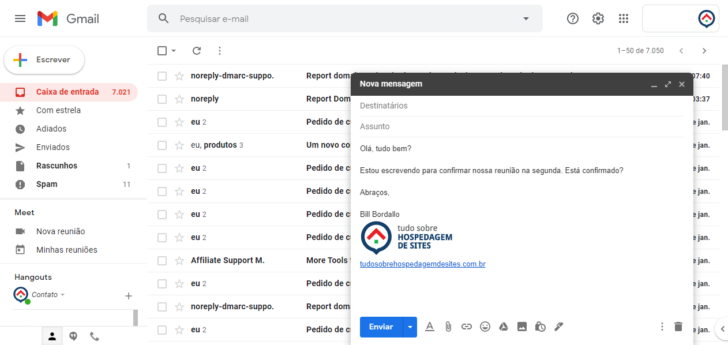
Google Workspace’s email service is built on the well-known Gmail platform, offering all of Gmail’s features to users without ads since it is a paid service. Additionally, storage space in Google Workspace plans exceeds that of regular Gmail accounts, starting at 30 GB in the Business Starter plan and increasing to 1 TB in the Business Standard plan and 5 TB in the Business Plus plan.
Google Workspace considers the same storage space for both emails and files in Drive, so they contribute to the total storage used. Files in Google format in Drive do not count towards the storage limit.
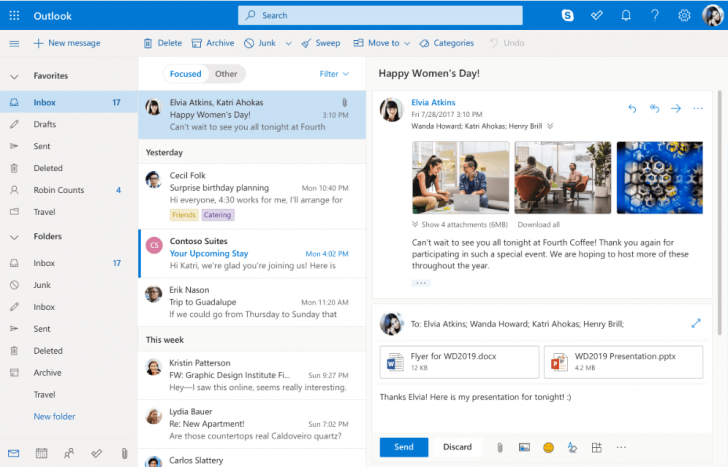
Microsoft 365 email, available on Outlook, a popular Microsoft platform, provides users with an ad-free experience and offers 50 GB of storage per user. In contrast, the free version of email on outlook.com only provides 15 GB of storage.
Microsoft separates email storage from file storage, so the amount of emails and attachments in your inbox does not use up OneDrive space, and vice versa.
Both services utilize the company’s personalized domain email address (e.g., joao@company.com) and provide a highly effective spam filter.
Microsoft provides a larger email storage space compared to Google Workspace, with 50 GB in Office 365 versus 30 GB in Google Workspace. This advantage is further emphasized by the fact that Google Workspace shares this space with Google Drive, unlike Office 365, where the storage is solely dedicated to email. Hence, Microsoft is the preferred choice in this aspect.
Google Workspace: Features, pricing, and guidance for utilizing professional tools
File storage in the cloud
Google Workspace utilizes Google Drive for storing files in the cloud. The Business Starter plan includes 30 GB that is shared with Gmail, with only non-Google format files taking up this space. Files created within the Google application suite, such as text, spreadsheets, and presentations, do not use storage space. This feature can be beneficial for companies using Google file formats as it can result in substantial space savings over time.
chsyys/GettyImages
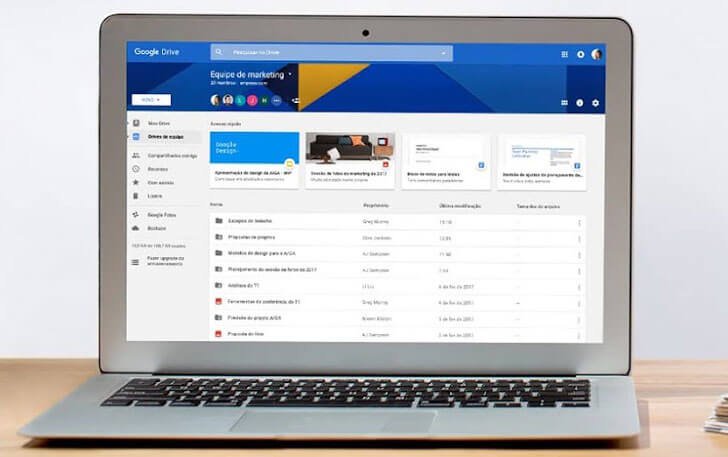
Google Workspace includes a synchronization feature called Drive for desktop, previously known as Drive File Stream. When this program is installed on a computer, all files from Google Drive can be viewed and accessed through the computer’s file explorer. A key benefit is that Drive for desktop doesn’t actually store the files on the computer; it simply indicates their presence. When a file is opened, it is streamed and can be edited and saved. This approach is useful for conserving storage space on the computer’s hard drive. Users also have the option to save specific files or folders offline instead of streaming them.
The cloud storage system in Microsoft 365 is OneDrive, providing 1 TB of cloud storage that is separate from email storage. However, any file stored in OneDrive takes up space.

OneDrive offers a desktop program that enables synchronization between local and cloud files, allowing users to stream files and conserve storage space. Unlike Google Workspace’s Drive for desktop, OneDrive permits syncing of multiple accounts on a single computer, whether they are business or personal accounts.
Both services enable sharing files with individuals inside or outside the organization, with the option for the service administrator to modify permissions as needed.
Microsoft 365 excels in storage capacity due to its ample space and capability to synchronize multiple accounts.
Suite of Programs
The program suite, along with professional email, is highly important and in demand in this type of service. Microsoft used to dominate this market due to its early monopoly. People above 30 are likely familiar with the Office package, which includes well-known programs like Microsoft Word, Excel, and Power Point. In the past, these programs were sold through one-time licenses rather than subscriptions, and users were required to install them on their computers.
Microsoft’s monopoly has shifted due to the rise of the Google suite, offering online programs for real-time collaboration without the need for installation. Google Workspace, introduced in 2006, is accessible for free to Gmail users, posing as a significant competitor to Microsoft.
Initially, Microsoft Office programs were more advanced in features compared to the newly introduced Google suite. Presently, many Microsoft users may prefer Office over other application suites, as using an installed program often provides a better experience than using a browser-based version, depending on internet connection and computer quality.
Microsoft has adapted its Office suite to include an online collaborative version, similar to Google Workspace, under the name Microsoft 365. The entry-level plan, Microsoft 365, offers only online access to Office programs, requiring a higher plan for installation on a computer.
In this comparison, we are looking at two closely related tools as both are fully online application suites.
Google has modernized the concept of office software by offering online programs in Google Workspace, which are now on par with Microsoft’s traditional desktop applications. Additionally, Google introduced popular file sharing and collaboration features that are widely utilized today.
When it comes to software suites, Microsoft is credited with pioneering them, but Google revolutionized them by adapting them for the internet age and enhancing collaboration.
Also check out: 10 reasons for professionals and companies to utilize Google Workspace.
Communication Instruments
Communication within a company, as well as with customers and partners, is a key feature in the service packages examined. While not as highlighted as email or office software, communication tools greatly enhance the efficiency of contemporary professionals.
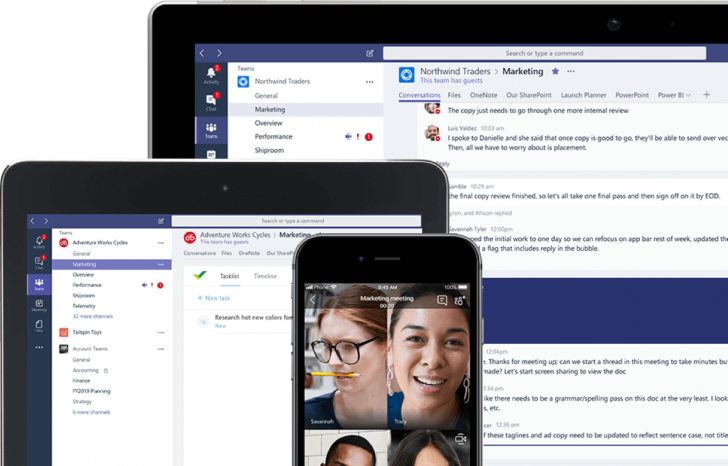
Microsoft 365 is focusing on promoting Teams as a live communication tool, offering features like video/audio meetings for up to 250 participants and chat platforms for individual or group discussions. Additionally, the package includes SharePoint for centralized communication, functioning as an intranet accessible online to organization members and invited users.
chsyys/GettyImages
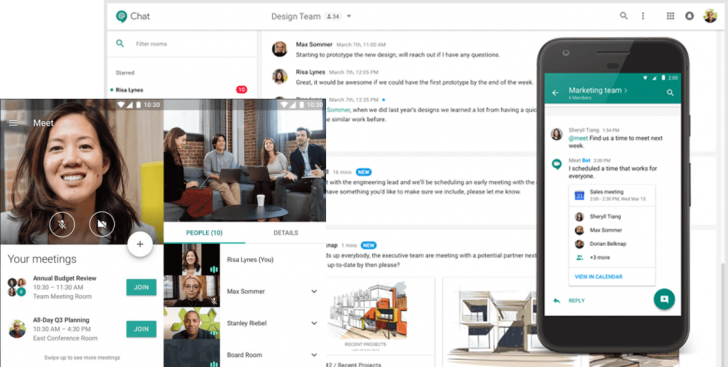
In Google Workspace, Google Meet serves as the platform for video and audio communication. It allows easy creation of meeting links for up to 100, 150, and 250 participants depending on the plan. Google Meet also offers integration with call platforms like Skype for Business, Cisco, and Polycom. Google Chat functions as the chat platform, facilitating private or group conversations and seamless attachment of documents from Google Drive. Google Sites acts as the intranet, enabling the creation of user-friendly websites that can be connected to custom domains and made public on the internet.
Both services also provide email distribution lists/groups, which can be beneficial for internal communication and fostering discussions on various topics.
Microsoft allows a maximum of 250 participants in real-time communication. The key consideration is whether making a call with such a large group is necessary or preferred. Beyond this, the features and reliability of the tools are comparable, leading to personal preferences based on user familiarity.
Mobile applications
Both platforms offer the option of remote work from any location worldwide. This is evident as the majority of resources are web-based and require only internet access and a browser. Additionally, both Google Workspace and Microsoft 365 provide various mobile apps for smartphones and tablets, enabling users to complete tasks without a computer.
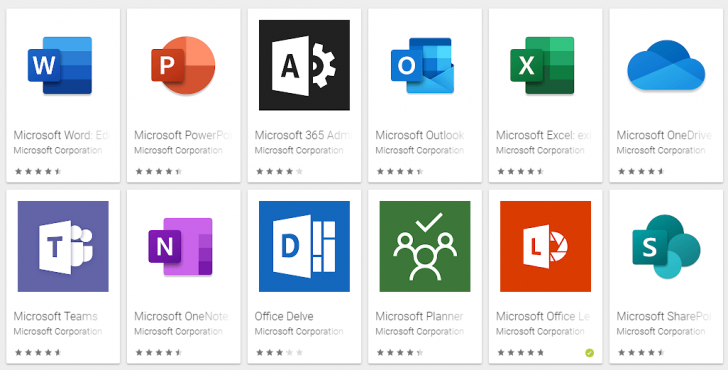
Microsoft 365 provides Android and iOS apps for popular suite programs like Word, Excel, PowerPoint, and OneDrive. This allows users to access and modify files in their account from any mobile device. The apps also feature real-time sharing and editing capabilities. Additionally, free access is offered to Outlook, Microsoft Teams, SharePoint, and other tools. Service administrators can use the Microsoft 365 Admin app to manage users and perform tasks available in the desktop version, enabling remote work in today’s mobile-centric era.
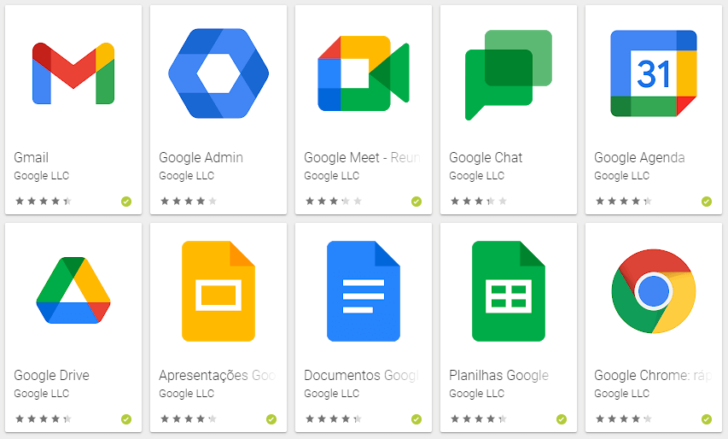
Google Workspace offers the ability to access, share, and modify different file types across tablets and smartphones through apps like Google Drive, Texts, Presentations, and Sheets. The Gmail app serves as the standard email tool, while real-time communication is supported through Google Chat and Google Meet. Service administrators utilize Google Admin to oversee users and Workspace features. Many Google apps used in free accounts are also available in Google Workspace, making it easy to access additional apps by logging in with the corporate account.
chsyys/Burst
Microsoft apps are more advanced in terms of complexity compared to Google apps, offering detailed editing features similar to desktop applications like Word, PowerPoint, and Excel. Google apps, on the other hand, provide a simpler and more intuitive user experience, which may give the impression of fewer features, but in reality, Google Workspace apps are just as powerful as Office 365 apps. Both platforms successfully cater to the goal of utilizing resources on mobile devices, emphasizing user-friendliness and adaptability.
Advanced Materials
Microsoft and Google provide compelling features in advanced technology.
Google Workspace provides user control capabilities such as password policy configuration, two-step verification, and enterprise mobile device management. Additionally, users can create distinct user groups with specific permissions and program usage rules. Higher-tier plans include Vault, a data retention and discovery service with integrated audit features to safeguard against accidental deletion or malicious actions. Cloud Search, a global search function, is also accessible to users on Standard and Plus plans.
Microsoft 365 provides multiple security features, such as safeguarding company data on employees’ mobile devices with a PIN, limiting copies and saves on these devices, setting email restrictions like “don’t forward” and encryption, and enabling data protection in case of theft or loss. Additionally, it allows for managing mobile access permissions and remotely erasing data and files.
Google Workspace utilizes Microsoft 365’s robust data retention tool and other advanced features in its offerings, with the caveat that the top-tier plans are required to access the best features of both platforms.
Assistance
Microsoft 365 and Google Workspace services provide assistance with setup and usage, primarily for system administrators. Regular organization users do not have direct access to support but can refer to detailed documentation for guidance.
Microsoft 365 technical support is available around the clock, seven days a week via phone with a toll-free number. For billing inquiries, support is available during business hours from Monday to Friday. You can also reach out to support by sending a message. Access to the support form can be found in the Microsoft 365 admin panel at admin.microsoft.com. Additionally, admins can refer to documentation available at docs.microsoft.com for further assistance. General users can access a help desk at support.office.com that contains articles on all available tools.
Google Workspace provides round-the-clock support via phone, email, and online chat, accessible to administrators through the Google Admin panel. The online chat feature is recommended for quick issue resolution, while a Portuguese 0800 phone service is also available 24/7. Additionally, administrators can utilize the help center, service status website, customer forum, and Google Cloud Connect community for support.
Comparison of prices between Google Workspace and Microsoft 365.
The competition between Google Workspace and Microsoft 365 has been intense in terms of pricing, with both offering similar plans at nearly the same price (R$ 28 for Google Workspace and R$ 27.43 for Microsoft).
Microsoft excels in the mid-tier market by offering a monthly payment plan for user-based licensing costs. It is crucial to compare the details to avoid any unexpected expenses. This plan includes the installation of Microsoft Office desktop programs, a feature highly sought after by users. In contrast, Google Workspace stands out for its larger storage capacity (2 TB compared to Microsoft’s 1 TB), Team Drive, and other features.
Google’s Business Plus is priced at R$ 105 per month per user, whereas Microsoft 365 Business Standard is available for R$ 80 per month per user at the highest level.
Both companies provide a higher-tier plan tailored for large corporations. Google Workspace offers the Enterprise plan, which requires contacting the sales team for pricing. Meanwhile, Microsoft 365 offers the Business Premium plan at a cost of R$ 140.80 per user per month.
The collection in both companies is now done in Real, which was not the case until recently.
Compare the plans to view the differences.
Google Workspace is a suite of productivity tools.
- Business Starter costs R$ 28 per user each month.
- Business Standard subscription costs R$ 70 per month for each user.
- Business Plus costs $105 per month for each user.
- Enterprise – upon demand
Microsoft 365:
- Business Basic costs $27.43 per user per month.
- Small and Medium Business Applications cost R$ 52.80 per user per month.
- Business Standard subscription costs R$ 80 per month for each user.
- Business Premium costs R$ 140.80 per user per month.
The Microsoft 365 Small and Medium Business Apps plan includes Office (installed and online) and OneDrive programs but does not include professional email and Teams.
Check out: Google Workspace Plans: which one is ideal and how to select?
Who provides the superior service: Google Workspace or Microsoft 365?
The decision between Google Workspace or Microsoft 365 can be influenced by factors such as the familiarity your company has with the respective tools. If employees are already using traditional Microsoft programs like Word, Excel, and PowerPoint, opting for Microsoft 365 may be beneficial due to the consistent usability. Conversely, if your company is already accustomed to Google’s collaborative tools, Google Workspace could be a suitable choice for a seamless transition.
The cost factor is important to consider, particularly for companies with a large number of employees. It is essential to assess the number of licenses needed, not just for the present but also for the future, as companies typically charge a monthly fee per active user.
Google Workspace and Microsoft 365 provide essential and strong services for contemporary businesses and professionals due to the involvement of two tech giants. Companies using either suite have access to effective communication and productivity tools.
If you have made a decision, feel free to ask any questions by leaving a comment, and I will be happy to assist you. If the issue has been resolved, you can choose one of the provided links to purchase your app suite.
Google Workspace and Microsoft 365 plans can be compared by looking at their respective plans.
Get a coupon here for a 10% discount on Google Workspace for a year!
Publication date: February 2, 2019 (last updated on June 15, 2023)
Tags: Comparison, Google Workspace, Microsoft 365, Office 365