


SiteGround, a hosting company, has significantly transformed itself recently, including migrating some infrastructure to Google Cloud in February. This move, announced on the company’s blog by the CEO, generated significant customer interest.
In 2019, the company decided to replace its well-known cPanel with its own control panel.
SiteGround is confident that its recent changes, although not universally popular, will enhance the customer experience and reinforce its position as a top choice for WordPress hosting.
Was the transition to Google Cloud beneficial? What differences have customers noticed in practice? How does performance compare in the new infrastructure?
We chose to document the steps and outcomes of transitioning from SiteGround’s hosting to Google Cloud Platform to address various inquiries.
SiteGround’s announcement regarding the transition to Google Cloud.
SiteGround CEO Tenko Nikolov declared on February 12 of this year that the company had initiated utilizing the Google Cloud platform to host a section of its infrastructure. The announcement was published on the company’s blog and can be accessed through this link.

Nikolov mentioned in the post that the company is always searching for new data center possibilities to provide advanced technologies and top-notch speed and reliability in customer-friendly locations. SiteGround tested various Cloud providers in 2019 and found that Google’s cloud service was the most suitable.
The first Google Cloud locations in use by the company include Iowa, USA; Eemshaven, Netherlands; London, UK; and Singapore. New customers are being activated in these locations, and some existing customers in the US and Europe will start to be transferred.
Advantages of Google Cloud, as per SiteGround
The company outlined the benefits they took into account when selecting Google Cloud as their infrastructure provider in the announcement.
Scaling and managing resources effortlessly.
For 15 years, SiteGround’s hosting platform utilized separate physical servers to reduce the chances of downtime by ensuring redundancy in equipment and resources, maintaining backups, and optimizing recovery procedures.
The Google Cloud infrastructure is based on virtual machines instead of bare metal servers, making it quicker and more efficient to create new virtual machines. Adjusting CPU, RAM, and storage features is also simpler, enabling the company to achieve its goals with reduced spending on idle and overloaded resources management.
High data redundancy through distributed storage
Cloud setup provides distributed storage, ensuring that customer website data is securely stored across multiple redundant Google SSD disks. This setup prevents data loss in the event of hardware failure, as data is not stored on a single physical machine. In case of a hosting server failure, a new virtual machine can be used to seamlessly attach the permanent SSD disk volume, eliminating the need for time-consuming backup recovery processes.
Top network for quicker websites
Google’s reputation for maintaining a speedy and robust network ensures that SiteGround customers’ websites will experience high performance. This advantage is particularly valuable as network connectivity problems are a leading cause of server downtime, which is minimized by leveraging Google’s network.
Numerous chances for establishing new data center sites.
Working with Google Cloud enables the company to easily expand to new locations beyond its current operating regions. SiteGround initially focused on regions with the highest customer presence, such as the USA and continental Europe.
The company mentioned on the blog that it plans to introduce 2 to 3 new regions soon, but did not provide specific details or a timeline.

100% compensation for renewable energy sources
Google’s commitment to sustainability is highlighted as a key benefit of selecting this Cloud service. This includes compensating for all energy used by its global renewable energy operations and maintaining carbon neutrality. Google has also excelled in energy efficiency by reducing data center emissions, improving delivery efficiency, and minimizing waste.
Customer Response
While some customers praised the company’s shift to Google Cloud, not everyone agreed with the decision.
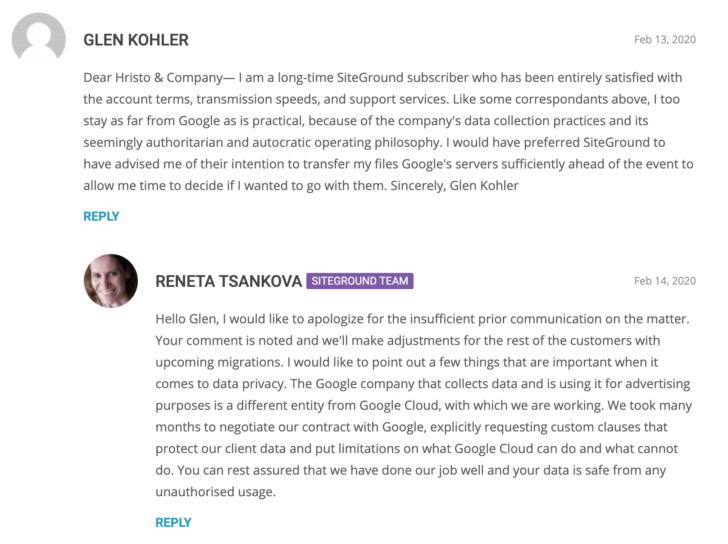
Some customers were unhappy with the decision as their data on Google servers made them feel vulnerable. This led to a boycott movement against Google, fueled by concerns over the company’s practices. Additionally, these customers felt further aggrieved because they were only informed about the migration after it had taken place, leaving them with no chance to explore other options.
SiteGround apologized for the delayed warning and stressed that the company is accountable for safeguarding and maintaining the security of customer data, as it is the sole entity with administrative access to its servers.
What is different (and what remains the same) after the SiteGround migration to Google Cloud.
After the announcement, uncertainties arise regarding how this change will affect individuals who are current or potential customers of SiteGround. To simplify comprehension, I have outlined a summary of the alterations and continuities for those remaining with SiteGround (as of the article’s release).
What was altered
- SiteGround’s data center infrastructure is now powered by the Google Cloud platform, using virtual machines in the cloud instead of individual physical servers.
- All SiteGround hosting plans, including shared and cloud servers, were affected by the change.
- The migration of the control panel from cPanel to Site Tools has been delayed as a result of moving to Google Cloud. Nevertheless, the company has confirmed that they are now continuing with the migration process.

What remains the same (following migration)
The following points remained the same after moving from SiteGround to Google Cloud Platform, but they may change in the future as companies are always evolving.
- SiteGround is still responsible for providing the service, while Google Cloud only furnishes the infrastructure.
- Prices will remain the same as the company migrates its infrastructure, as stated by the company.
- SiteGround’s existing customers have remained in their current server locations, while new customers have the option to select a data center when signing up. Although no new regions have been introduced yet, there are plans to launch 2 to 3 new locations in the near future. It is uncertain whether Brazil will be included, but it is a possibility given Google Cloud’s presence in the country.
- The scalability of the service is limited because shared plans and server setups are still in place, even though the system operates in the Cloud. This means that customers cannot fully utilize the benefits of Cloud technology, such as purchasing additional features without upgrading their plan.
- Dedicated servers will not be transferred to Google Cloud initially.
- SiteGround is accountable for safeguarding and keeping your customers’ data secure and confidential. Google does not have administrative access to the servers and is not authorized to handle or utilize the customer data in any way.
- The company stated that it has opted for different services instead of using Google’s CDN and DNS. They have chosen to continue using Cloudflare integration.
What is the distinction between hosting on SiteGround or hosting directly on Google Cloud?
Google Cloud services are different from those aimed at regular end users, such as entrepreneurs, freelancers, bloggers, and others in non-tech fields.
When you hire Google Cloud directly, the contractor must handle server administration tasks, which can be insufficient in many instances. SiteGround, on the other hand, addresses this issue by setting up and overseeing servers and offering user interfaces, like a user-friendly control panel. This service complements Google’s infrastructure.
This method may lack the scalability of hosting directly in a Cloud solution, but it offers a stable and reliable solution without the added complexity, along with accessible technical support for any inquiries.
SiteGround offers hosting plans starting at $6.99 per month.
The transfer from SiteGround to Google Cloud.
In any infrastructure migration process, one of the main concerns for clients is the availability and performance of the new data center, even when switching to a top cloud provider like Google Cloud.
We chose to monitor server performance for 30 days after migrating the data center to assess the impact of the change.
On February 12, we were informed through SiteGround’s blog post that the company had moved to Google Cloud infrastructure. Approximately 20 days later, on March 2, we received an email from SiteGround confirming the successful migration of our account and providing instructions for handling specific situations. The migration essentially involved a switch in server IP address. Since our website hosted with them does not rely on the IP address directly, no action was required on our end.

chsyys/Pexels
Performance and availability prior to the migration.
SiteGround has been consistently monitored by us over the years, with very few instances of not achieving 100% uptime. Its performance has consistently ranked among the top when compared to other companies in the industry.
Monitoring results from the 12 months before data center migration show 100% uptime and an average response time of 432 ms. The Uptime Robot tool used for monitoring has primary servers in Dallas, Texas, while the SiteGround data center used before migration is located in Chicago, USA.

We highly advise monitoring your hosting uptime to stay informed about any possible downtime issues and track server performance. Follow a step-by-step guide in this article to set up site monitoring using a free tool.
Impacts while migrating
The migration took place on March 2, according to SiteGround. During that time, the server was not accessible for half an hour, from 06:01 to 06:31 (São Paulo time), as indicated by the screen monitoring.

chsyys/FreePik
A slight rise in response time was noticed in the days following the migration. The survey spanned a longer duration of 2 months to capture the response time trend, resulting in an uptime of 99.965%. If the analysis period had been just 1 month, the uptime would have been 99.932%.
The monitored site was transferred to a Google Cloud data center in Chicago, USA, without changing its region.
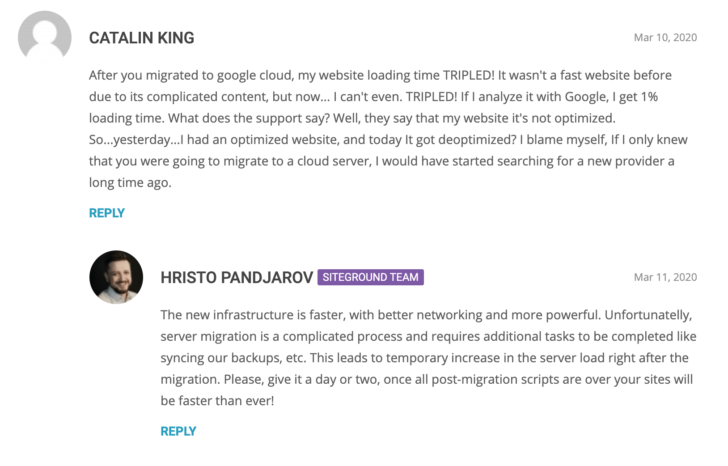
The company explained to a client that the increase in response time was due to the complex process of server migration, which involves completing additional tasks like synchronizing backups. They assured the client that the server loading would improve once all post-migration scripts were completed, and the sites would be faster than ever within a day or two.
Results will be seen 30 days after the migration.
SiteGround has been using Google Cloud’s infrastructure for just over 30 days, giving a glimpse into the performance and availability of this new setting.
The accommodation availability we track has remained at 100% over the thirty days following the server migration from March 3 to April 2, 2020. Despite a slightly higher average response time of 559 ms post-migration, all other factors, such as the server location in Chicago, USA, have remained consistent.

SiteGround support was contacted via ticket to inquire about the discrepancy. They responded promptly, stating they needed to investigate further and would provide an update soon. After four hours, they replied with the following message (translated to Portuguese).
Time for the initial byte can fluctuate due to various factors such as connectivity interference and server load during testing. If you observe a consistent rise in your TTFB (time to first byte), there are certain factors to take into account.
The account was recently moved to the Google Cloud platform and various tasks are still being addressed, such as creating backups and distributing the load.
Migration to Google Cloud happened at the same time as the unfortunate outbreak of the Covid-19 pandemic, which also impacted it. Worldwide, all networks are much more congested during this period.
The situation typically gets better with time.
SiteGround’s response times for shared hosting are among the quickest, even when measured from the US. However, if the measurements were taken from Brazil, the times would likely be longer due to the distance from the data center, which is a common issue for servers located outside the country.
Was the SiteGround migration to Google Cloud successful in the end?
I believe that SiteGround’s decision to move infrastructure to a Cloud platform, especially one as advanced as Google’s, was a wise choice given the numerous benefits of this solution, despite differing opinions on the change.
More than one hosting company, such as SiteGround, presents itself as a service provider, distinguishing itself in customer experience. It is worth noting that WordPress.org recommends it.
If you are a SiteGround customer, please tell us about your experience with their services. If you haven’t tried it yet, I suggest considering it for reliable hosting, strong technical support, and reasonable pricing. Hosting plans start at $6.99 per month in the first year. Visit SiteGround’s website for more information.
Published on 09/04/2020 and revised on 19/08/2020.
Google and WebsiteGround are tagged.